Image
— An Interview with Drupal Founder Dries Buytaert —
In 2026, Drupal—a platform beloved across the globe—reached the significant milestone of its 25th anniversary. To commemorate this landmark year, we are presenting a special interview series featuring the invaluable insights shared by leaders at DrupalCon Nara last autumn.
While Drupal has supported the evolution of the web for a quarter-century, it now stands on the threshold of a new era, looking toward the "next 25 years". In this period of transformation—unprecedented even in its long history—what should serve as our guiding principles?
Artificial intelligence is rapidly transforming how websites are built, managed, and scaled.
What was once considered a productivity tool has become a fundamental shift in how the web itself works.
For open source projects, this shift raises important questions:
To explore these questions, we spoke with Dries Buytaert, founder of Drupal, one of the world’s most widely used open source CMS platforms.
Note: In this article, comments made by Drupal founder Dries Buytaert are italicized.
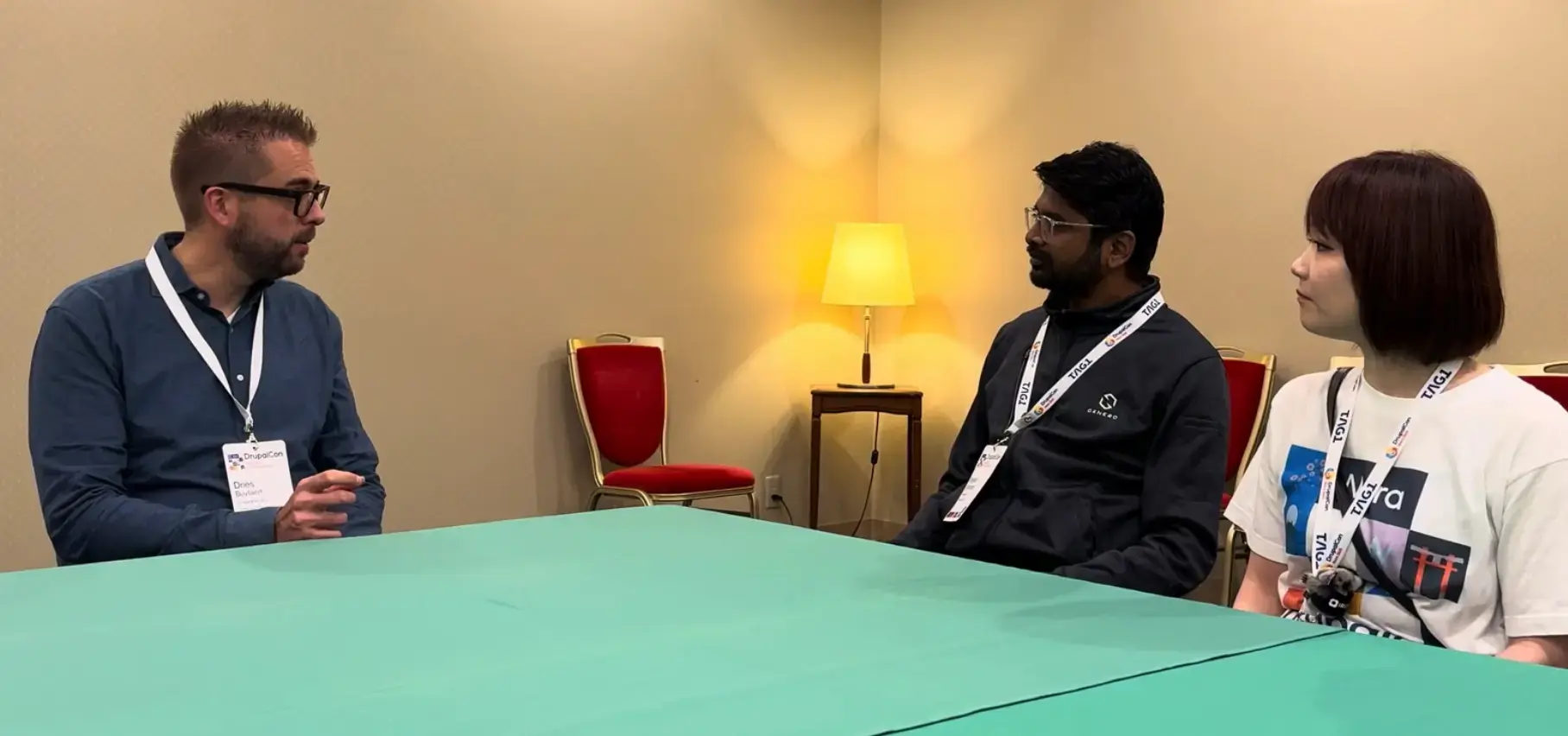
At the DrupalCon Nara 2025 venue: An interview between Dries Buytaert and DXTimes.
Drupal was created more than 25 years ago, long before mobile-first design, cloud computing, or large-scale AI models existed.
Looking ahead, Dries sees AI as one of the most significant transformations the web has ever experienced.
“What I’m most focused on right now is ensuring that Drupal remains relevant in an AI-first world. Honestly, this alone could keep us busy for the next ten years.”
While AI adoption is moving quickly, Dries believes that many organizations will take five to seven years to fully integrate AI into core systems. This long horizon creates both urgency and opportunity for open source platforms like Drupal.
Within open source communities, AI often sparks concern.
Dries openly acknowledges these mixed emotions.
“To be honest, AI is scary. But at the same time, it’s incredibly exciting.”
One reason is accessibility. Drupal is powerful, but its flexibility can come with a steep learning curve. AI has the potential to lower that barrier and make open source tools accessible to a much broader audience.
“AI can help millions more people build on open source. That’s a huge opportunity.”
Rather than replacing open source, Dries sees AI as an enabler—one that can amplify its impact.
Drupal’s architecture offers unique advantages in an AI-driven environment:
These characteristics align naturally with AI-assisted content creation, personalization, and automation.
“Drupal’s strengths actually become more valuable in an AI-first world. AI doesn’t replace them—it enhances them.”
A core principle behind Drupal’s AI strategy is choice.
Drupal introduces an abstraction layer that allows organizations to:
This approach is especially important for organizations concerned about data sovereignty and compliance.
Drupal’s approach to AI emphasizes governance and transparency.
“We don’t want AI to make final decisions on behalf of people.”
AI can generate suggestions, automate tasks, and surface insights—but humans remain responsible for approval and accountability. This principle is essential for enterprise and public-sector use.
As AI systems become increasingly opaque, open source offers an alternative: transparency.
Open code allows communities to:
“We want to engage with AI based on principles and values—not just convenience.”
For Drupal, open source is not a constraint in the AI era—it is a foundation.
AI presents both risk and opportunity for open source.
Drupal’s response is neither resistance nor blind adoption, but thoughtful integration grounded in open values.
In Part 2, we’ll explore why Drupal continues to be trusted by enterprises and governments, focusing on security, governance, and long-term sustainability.
【Part 2】Why Drupal Continues to Be Chosen by Enterprises and Governments