AI-Native Transformation and the Digital Future of Japan — Special Dialogue: Phil Knight (SAFe/Scaled Agile)×Hiroshi Takeuchi,(Genero)
We are pleased to present a conversation between Phil Knight, a senior leader at SAFe (Scaled Agile), and Hiroshi Takeuchi, Managing Director of Genero,Inc.
In this discussion, they explore a wide range of topics, including global trends in AI adoption, the shift toward becoming “AI Native,” the potential of the EDGE framework, and the unique digital challenges facing Japan. The dialogue offers insights into the perspectives needed to drive digital transformation in Japan, as well as key decision-making principles for the next generation of leaders.
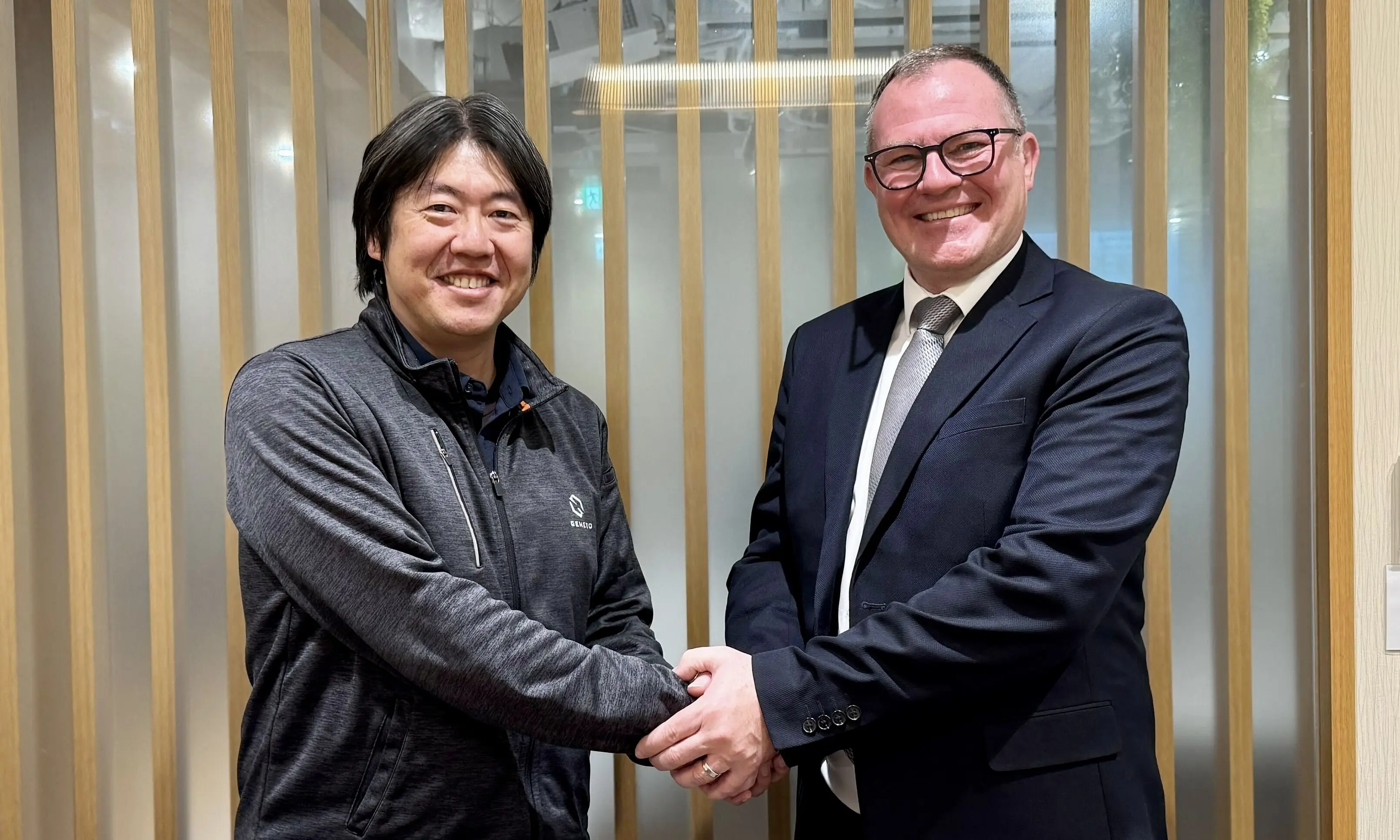
Our Managing Director, Hiroshi Takeuchi (left), and Phil Knight from SAFe / Scaled Agile, Inc.

Part 1: Global Trends — Why “AI Native” Now?
Takeuchi:
Scaled Agile, Inc. (SAI) has recently launched its “AI Native” class in the Japanese market. SAFe has long been a leading organization supporting Fortune 500 companies. Why introduce this new initiative now? What changes are you seeing in the global market?
Phil:
There are several reasons. When we look at the global adoption of Agile, maturity levels vary by country. Scandinavia was one of the first regions outside the U.S. to adopt Agile, and also among the first to adopt SAFe. Today, that market is quite mature, with approximately 2.5 million people trained worldwide. In some regions, opportunities for continued large-scale training are beginning to decline.
At the same time, there are growth areas. Southeast Asia continues to grow steadily, and Australia is also expanding. Sectors that were slower to adopt Agile—such as government and manufacturing—are now gaining momentum.
However, right now, AI is capturing all the attention. In every conversation I’ve been part of, AI has become a central topic.
Takeuchi:
What challenges are organizations facing when adopting AI?
Phil:
In Japan, the situation is neither particularly advanced nor behind compared to other countries. The challenges around AI adoption are largely universal.
Many organizations are investing in AI, but they are not seeing sufficient returns. Often, “investment” means providing employees with tools like Copilot licenses and offering online training to encourage usage.
In reality, however, most people are still using AI as an advanced search tool. Even when more sophisticated prompts are used, AI is often treated simply as a knowledge base.
On the other hand, agentic AI has the potential to be a true game changer.
Takeuchi:
Could you share a concrete example?
Phil:
Of course. A marketer on my team needed to review around 1,600 courses listed on a public training calendar to identify partners who were unfairly discounting prices. She had no technical background.
Manually, this would have taken weeks. But having just completed a basic AI training, she said, “I can do this with an agent.” By the next morning, she had produced a spreadsheet identifying key violators, top-performing partners, and average pricing.
She had built an agent workflow that accessed websites, crawled partner pages, extracted pricing, and organized the data automatically.
Another example: we ran a half-day workshop for 30 people at PMI. One project manager used to spend every Monday morning gathering project data, then the afternoon compiling it into a PowerPoint for executives—about 20% of his weekly workload.
Within an hour, he built a workflow that now completes this task in minutes. While he drinks coffee on Monday morning, the process runs automatically—freeing up 20% of his time.
Phil:
You attended the AI Native training in India, didn’t you?
What insights did you gain personally?
Takeuchi:
Interestingly, the training impacted me even more than the engineers who accompanied me. My biggest realization was that as a managing director and head of sales, I am the one who should orchestrate the organization using AI. That, to me, is the essence of being “AI Native.” It was a profound insight.
Phil:
Exactly. This is about mindset. AI Native means AI becomes as natural and ubiquitous as the internet. Just as we don’t say, “I used the internet,” AI should become a seamless partner in all aspects of work.
We recognized a significant gap in the market. While tools and short online trainings exist, very few actually lead to meaningful productivity gains. Many people still don’t see AI as a true partner.
Part 2: The EDGE Framework
Takeuchi:
Could you briefly explain what “EDGE” is and how it impacts organizational culture?
Phil:
“EDGE” is an acronym that explains why this technological revolution is different from any before:
- E — Exponential:
It took 16 years for mobile phones to reach 100 million users, 7 years for the internet, but only 2 months for ChatGPT. This illustrates the speed of change today. - D — Disruptive:
Traditional roles and jobs are rapidly evolving. Lawyers, translators, developers—many professions are being redefined. In the future, Agile teams may consist of two developers and AI agents instead of 7–9 people, delivering in days instead of weeks. - G — Generative:
AI creates things that never existed before. Given a goal, it can determine how to achieve it autonomously. However, this also introduces a “black box” problem—understanding how outputs are generated becomes more difficult, raising questions about governance and auditability. - E — Emergent:
AI behavior is inherently unpredictable. It is impossible to fully control what will happen.
What we want to emphasize is that unprecedented change is already happening at an unprecedented speed and level of uncertainty—and it is not temporary. Organizations must adapt accordingly.
Part 3: Japan-Specific Challenges
Takeuchi:
In Japan, many companies still operate under traditional governance models, and Agile adoption remains limited. There is also the so-called “PoC graveyard” issue. How do you view Japan-specific challenges?
Phil:
First, it’s important to clarify that while adopting SAFe itself is not mandatory, Agile thinking is essential.
If you are experimenting, you must fail fast, learn quickly, and iterate continuously—while prioritizing collaboration and communication.
AI transformation cannot be treated as an 18-month project. AI evolves in 18-day cycles, not 18 months.
In Japan, Agile adoption is still developing. Rather than immature, it’s more accurate to say it is at a stage of expansion. Some companies are already shifting toward Agile to compete globally—this is steady progress.
However, many organizations still maintain hierarchical cultures. This transition takes time, but it follows patterns seen in other countries. Once a few companies demonstrate success, adoption accelerates rapidly. Takeuchi:
One issue I see is that AI and Agile are often treated separately. While AI adoption is encouraged, there isn’t enough recognition that Agile is essential to make it work.
Phil:
AI is inherently uncertain and evolves continuously, so organisations need Agile ways of working to test, learn, and adapt quickly rather than relying on fixed, upfront plans. Without Agile, AI efforts stall in pilots, struggle with governance and risk, and fail to embed into day-to-day business workflows.
Part 4: A Message to Leaders in Japan
Takeuchi:
Phil, what message would you give to DX leaders in Japan?
Phil:
I recently spoke with a leader who said they weren’t ready yet—that they might need to wait for organizational restructuring.
My message is simple: don’t wait.
What’s happening now is a massive wave of change. There’s a great book called The Coming Wave by Mustafa Suleyman with Michael Bhaskar which highlights this coming wave but in my opinion, the wave has already arrived.
Saying “we won’t use AI” is like saying “we won’t use the internet.” AI is already here—and it’s not going away.
You must embrace it and move proactively. Otherwise, competitors will adopt AI and rapidly widen the gap.
Again—don’t wait.
Takeuchi:
There are also misunderstandings about Agile, aren’t there?
Phil:
Yes. Some people think Agile lacks rules, rigor, or planning—but in reality, it’s the opposite.
Agile is often more rigorous, more structured, and more collaborative than traditional approaches. With traditional methods, things may appear fine until issues suddenly surface too late.
With Agile, you validate as you go, pivot when needed, and continuously improve. Throughout the process, close communication and alignment are maintained. We can support organizations in both understanding and practicing this.
Reflection on the Discussion
This conversation makes it clear that becoming “AI Native” is not merely about adopting technology—it requires a transformation of organizational mindset and ways of working.
While companies worldwide are investing in AI, many fail to unlock its full value, treating it as just an efficiency tool within existing processes. However, with the rise of agentic AI, we are entering a phase where humans and AI collaborate to redesign work itself.
The essence of this shift is captured in “EDGE” (Exponential, Disruptive, Generative, Emergent), highlighting the unprecedented speed and uncertainty organizations must now navigate.
In Japan, challenges such as the “PoC graveyard” and traditional governance models have slowed the integration of AI and Agile. To succeed, organizations must start with fundamental questions—why they are pursuing AI and what they aim to achieve—and embed continuous experimentation and learning based on Agile principles.
Above all, leaders themselves must evolve into orchestrators who make decisions and lead with AI at the core.
AI is already an irreversible force. Waiting is no longer an option. Organizations that embrace and proactively leverage this transformation will be the ones to secure competitive advantage in the years ahead.
About Genero, Inc.
Genero,Inc. is a digital agency that supports organizations in transforming into “AI-Native” enterprises by combining the open-source platform Drupal, agile methodologies, and AI technologies.
The company provides strategic approaches and specialized expertise to address clients’ business challenges, offering consulting services across a wide range of areas including business process optimization, organizational reform, and digital transformation.
From strategy development to talent cultivation, Genero delivers end-to-end support while deeply integrating cutting-edge AI technologies into organizational decision-making and day-to-day business systems. Through this approach, the company helps organizations continuously create value and make rapid decisions, enabling them to remain resilient and adaptive in times of constant change.
Company Overview
Company Name: Genero,Inc.
Representative: Hiroshi Takeuchi, Managing Director
Head Office: SANNO BRIDGE, 2-5-6 Sanno, Ota-ku, Tokyo, Japan
Established: April 2003
Business Activities:
- AI implementation support
- Agile organizational transformation consulting
- Digital marketing support
- Development and operation of open-source systems
Website: https://genero.jp/
Website: https://genero.jp/